Has Octopus Got Too Many Tariffs?
A cheaper energy tariff should be good news. But Intelligent Octopus Go Loyal Fixed left me asking a different question: what does loyalty actually mean? I remained an Octopus customer throughout the summer, using Flux, yet the offer’s wording apparently excluded me because I was not already on Intelligent Go.
This is not about begrudging anyone a saving. If the offer reduces your bill, that is welcome. It is about understanding why loyalty appears to depend on which product you use, and whether choosing an energy tariff has become unnecessarily complicated.
What the offer said
The offer reviewed in the video advertised a twelve-month fix, a £50 early exit fee and an off-peak rate of 6.6p/kWh from 1 October 2026. It was described as exclusively available to existing Intelligent Octopus Go customers. Those are the terms examined for the recording; check your own quote for availability and regional prices.
Our comparison found lower day and night rates than the standard fixed offer checked at the same time, with the same standing charge. That does not establish that it beats an existing customer’s older agreement. The whole bill matters more than one attractive number.
Why does loyalty depend on the tariff?
Spending the summer on Flux did not mean leaving Octopus. That is why the wording jars. Is this discount rewarding a continuing customer relationship, participation in smart charging, or staying on a particular product?
There may be sound commercial and operational reasons for the distinction. Flexible EV charging gives a supplier control over when a substantial electricity load runs. I do not have Octopus’s profitability figures, so I cannot say that profitability determines eligibility. I would simply like a clear explanation of what is being rewarded.
Solar and batteries without an EV
Viewers regularly ask why their solar panels and home batteries do not unlock the same eye-catching rates as an electric car. Their homes can shift demand too, so the question is understandable.
Flux and Intelligent Flux already serve solar and battery households, while Cosy is designed for heat pumps. Those options should not be ignored. Nor should we assume a low overnight import price beats a better export payment. Batteries, cars and heating also offer different kinds of flexibility. Customers need those differences explained in terms of their total costs.
Choice needs to be manageable
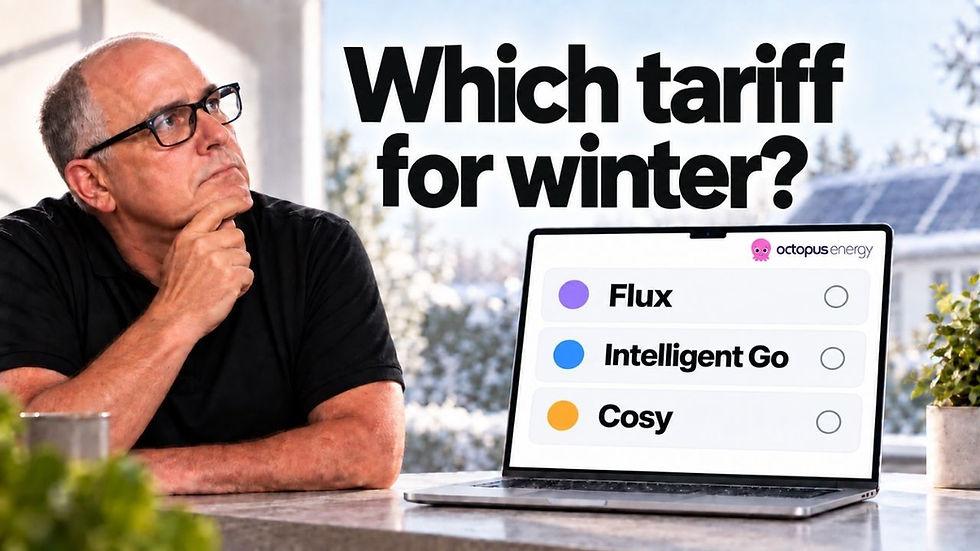
Our 29 September 2026 API check counted 21 Octopus-branded domestic import products and ten export products, including specialist and prepayment products. Multiplying them gives 210 theoretical pairings, not 210 combinations a household can actually choose. Compatibility and eligibility reduce that number.
Even within Intelligent Go, customers may encounter Variable, EV Saver, Fixed and Loyal Fixed versions. Existing agreements and offers available to join are not the same list. Working out that distinction is another task before comparing prices.
Phil Steele’s smart-tariff guide is a useful attempt to explain the choices. But the combinations of EVs, heat pumps, solar and batteries illustrate why a simple price list is insufficient. Other suppliers also divide their ranges by technology; the E.ON Next examples discussed in the video show this is a wider issue.
What would help?
Show customers only eligible products. Compare compatible import and export tariffs together. Estimate annual costs from consumption data, explaining any assumptions about changing usage times. Make exit fees and restrictions visible, and alert existing customers to better suitable offers.
I am not asking for identical tariffs for every home. I am asking suppliers to make useful choice easier to navigate. Does your tariff reflect what your home can offer, or does finding the right deal still feel like homework?


Comments