Is Octopus Flux the Best Summer Tariff? My Real 2026 Results
In July, my electricity account didn’t end with me receiving a bill.
It ended with Octopus owing me £126.42.
That is probably the best monthly electricity result I have recorded. It happened during my first complete month after switching from Intelligent Octopus Go to Octopus Flux.
On the face of it, that makes Flux look like the obvious winner—particularly for a home with solar panels and battery storage.
But the headline figure hides an important complication.
Flux made my electricity considerably more profitable, but it also made charging our two electric cars much more involved. With Intelligent Go, we could plug in the cars and allow Octopus to create the charging schedule. Under Flux, I found myself watching the weather, checking the home batteries and deciding where every available kilowatt-hour would be most valuable.
Should the solar charge the house battery?
Should it go into one of the cars?
Should I use it to heat the hot tub or produce hot water?
Or should I export it to the grid during the most valuable period?
So, did I genuinely choose a better tariff—or did I trade simplicity for a system that only works because I am actively managing it?

Why I moved away from Intelligent Octopus Go
Intelligent Octopus Go is designed to make electric-car charging straightforward.
You connect the car, tell Octopus how much energy it needs and when it needs to be ready, and Octopus creates a charging schedule. In our house, that convenience is especially valuable because we have two electric vehicles.
One vehicle could be managed through Intelligent Go, while the other was charged as a normal household load during the inexpensive overnight period.
The cars effectively became a background part of the home. We generally didn’t need to think about when they charged.
However, our home also has solar panels and battery storage. During the summer, that changes the financial calculation.
When the solar panels are producing more electricity than the house requires, I have several potential uses for the surplus:
Store it in the home batteries
Charge one or both electric cars
Heat the hot tub
Use the heat pump to produce hot water
Export it to the electricity grid
Octopus Flux applies different import and export prices at different times of day. This creates an opportunity to retain energy when it is less valuable and export it when the grid—and the tariff—places a higher value on it.
The question was whether that opportunity would justify giving up the simplicity of Intelligent Go.

June 2026: the transition month
June was the month in which we moved to Flux.
Because the switch happened during the month, June is not a controlled comparison between two tariffs. Roughly half of the month reflects our previous Intelligent Go strategy, while the remainder reflects the beginning of the Flux strategy.
Nevertheless, June provides a useful starting point.
June 2026 result | Amount |
Electricity imported | 429.9 kWh |
Electricity exported | 625.6 kWh |
Import cost | £43.71 |
Export credits | £109.59 |
Axle Energy VPP earnings | £26.35 |
Standing charge | £15.90 |
Final result | £76.33 credit |
A monthly electricity credit of £76.33 is already an excellent result. It means we paid nothing overall for the electricity we used, and the account still ended significantly in our favour.
However, June’s result was slightly below the equivalent month in 2025.
One important factor is that our standard export rate had fallen from 15 pence to 12 pence per kilowatt-hour during early 2026. Weather, household consumption and driving requirements may also have contributed.
July would provide the first complete month under the Flux strategy.
That is where the figures changed dramatically.

July 2026: my first complete month on Flux
During July, our home imported only 77.3 kWh of electricity.
In June, we had imported 429.9 kWh.
That represents a reduction of approximately 82%.
Comparison | June 2026 | July 2026 | Change |
Electricity imported | 429.9 kWh | 77.3 kWh | -82% |
Electricity exported | 625.6 kWh | 543.4 kWh | -13% |
Import cost | £43.71 | £15.23 | -65% |
Export credits | £109.59 | £141.34 | +29% |
Axle Energy earnings | £26.35 | £16.48 | — |
Final result | £76.33 credit | £126.42 credit | +£50.09 |
The most interesting part is not the reduction in imports.
It is what happened to our exports.
We exported approximately 13% less electricity during July than we had during June, yet the value of those exports increased by around 29%.
June’s exported electricity earned £109.59.
July’s exported electricity earned £141.34.
This demonstrates one of the principal advantages of Flux. The result is not determined only by how much electricity you export. It is also determined by when you export it.
By retaining enough energy to export during the more valuable period, each exported kilowatt-hour can earn considerably more.
After import charges, the standing charge, export payments and Axle Energy earnings were included, July finished with a credit of £126.42.
That was my best monthly electricity result since I began recording the data.

Did virtual power plant payments create the result?
July included two Axle Energy virtual power plant events, which contributed £16.48.
Those payments certainly improved the final figure, but they did not create the overall success.
Without the Axle Energy income, July would still have ended approximately £109.94 in credit.
That would still have been an exceptional result and, based on my records, a record month.
The virtual power plant events should therefore be treated as an additional benefit rather than the sole reason Flux performed so well.
Comparing July 2025 with July 2026
The year-on-year comparison makes July’s result look even more impressive.
July result | Final balance |
July 2025 | £31.39 credit |
July 2026 | £126.42 credit |
Improvement | £95.03 |
The July 2026 credit was approximately four times the credit achieved during July 2025.
If I only considered those two months, it would be easy to declare Flux the clear winner.
However, one summer month cannot tell us how a tariff will perform across an entire year.
Solar generation changes considerably between seasons. Our driving habits change, household consumption increases during colder weather, and the heat pump begins heating the home.
The opportunity to export large quantities of electricity during valuable periods will also fall as the days become shorter.
July proves that Flux can perform extremely well under favourable conditions. It does not prove that Flux will be the best tariff in every season.

The hidden cost of the better financial result
The financial result was excellent, but achieving it felt very different from using Intelligent Go.
With Intelligent Go, the cars were charged according to an automatic schedule.
Under Flux, charging became dependent on energy availability across the entire home.
On a strong solar day, the arrangement can work brilliantly. The solar panels can run the house, charge the home battery, send electricity into one or both cars and heat the hot tub.
There may still be enough stored electricity available to export a significant amount during the valuable Flux period between 4pm and 7pm.
But solar generation is never completely predictable.
A forecast may show sunshine, only for a bank of cloud to arrive. One car might return home requiring a substantial charge, while the second car may also be needed the following morning.
At the same time, the home battery could be partly depleted, and the house still needs enough energy to get through the evening.
I then have to decide where the available electricity is most valuable.
Should it charge the battery or one of the cars?
Should I split it between both vehicles?
Should I retain the energy to avoid importing later?
Or should I export it at the high rate and potentially import electricity again when the cars need charging?
Flux asks me to optimise the entire home.
That can put more money in my pocket, but it is considerably more complicated.
Did Flux really reduce our imports by 82%?
The reduction from 429.9 kWh in June to 77.3 kWh in July is dramatic.
However, this is real household data rather than a controlled experiment.
The weather was not identical. Solar generation, driving requirements and household consumption were not identical. June also contained usage under two different tariffs.
Changing to Flux influenced how electricity moved around the home. Charging the cars from available solar will also have reduced the amount imported from the grid.
But I cannot claim that the tariff alone caused every part of the 82% reduction.
What I can say is that the combination of Flux, solar panels, battery storage and more active energy management produced an exceptionally low-import month.
That remains significant, but another household should not assume it will automatically achieve the same result.
The wider year-to-date comparison
July was exceptional, but the wider figures provide some necessary context.
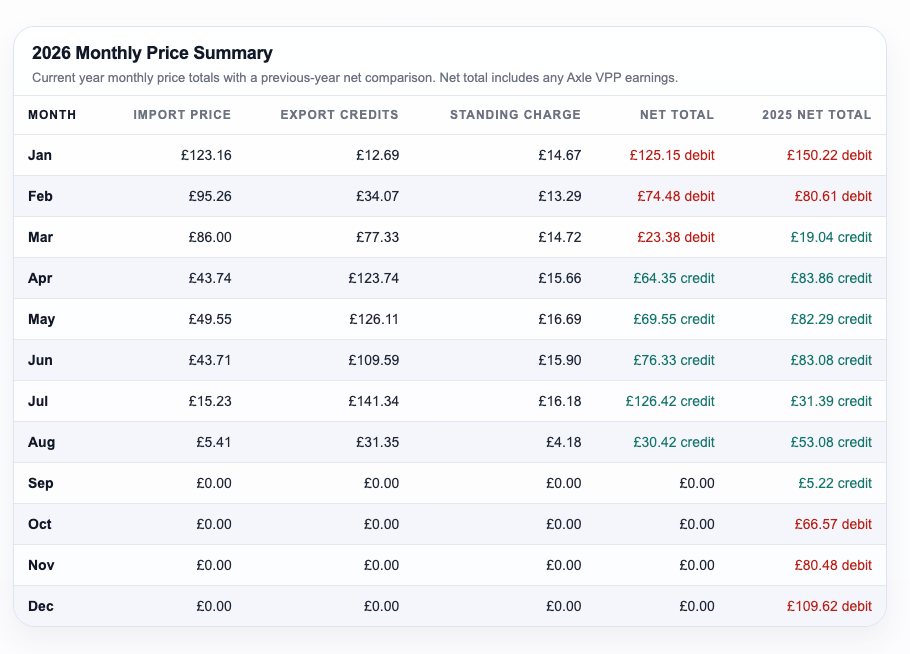
From January to the first few days of August, the 2026 data showed a total electricity-account credit of £137.33.
The equivalent monthly period during 2025 produced approximately £121.91 of credit.
That means the overall year-to-date improvement was only around £15.42.
July improved by more than £95 compared with July 2025, but much of that advantage was offset by the results from earlier months—particularly after the standard export rate fell from 15p to 12p per kilowatt-hour.
One outstanding summer month does not automatically make one tariff better across an entire year.
Will I remain on Flux during winter?
Flux appears particularly well suited to periods of strong solar generation.
During summer, there can be enough electricity to run the house, charge the battery, put energy into the cars and still export to the grid.
During winter, all those uses will compete for a much smaller amount of available solar.
The home battery may need to be charged from the grid more frequently. The cars will still require energy, household consumption will increase, and the heat pump will begin heating the home.
There will also be far less surplus electricity available during the valuable export period.
That could significantly change the financial calculation and make Intelligent Go’s automatic inexpensive charging slots much more attractive again.
My current expectation is that I will remain on Flux while it continues producing a financial advantage. When falling solar generation means the tariff begins costing more than it saves, I will seriously consider switching back to Intelligent Go for winter.
Is Octopus Flux worth it?
Based on July’s financial result, switching to Flux was worth it.
A monthly credit of £126.42 is exceptional. We imported very little electricity and earned more from July’s exports despite exporting less energy than we had in June.
The home batteries also generated additional income through virtual power plant events.
But Flux requires much more active involvement.
Charging two electric cars is no longer something I can leave entirely to an automatic schedule. The decision depends on the weather, the energy required by each car, the state of the home batteries, predicted household consumption and how much electricity I want available during the valuable export period.
Flux delivered a better summer financial result.
Intelligent Go delivered a much simpler charging experience.
The right tariff therefore depends on what you value most.
If you have solar panels, battery storage, flexible electricity consumption and the willingness to manage everything actively, Flux can be extremely rewarding.
If your priority is predictable and effortless EV charging, Intelligent Go remains difficult to beat.
For me, July proves that the Flux experiment is working.
Winter will determine whether it works for the entire year—or whether I switch back to Intelligent Go.
You can examine my complete import and export data on my Energy Bill Data page.
Which tariff are you currently using? Do you actively manage your solar, battery, EV charging and exports, or would you prefer to let the system handle everything automatically?
Watch the full video here: https://youtu.be/ZmfayzutWzM
Disclaimer
This article describes my personal household energy usage and tariff experience. It is not financial advice or a controlled tariff comparison. Electricity prices, tariff availability, export rates and individual results vary according to region, equipment, weather, consumption and driving requirements. Check the current tariff terms before making a decision.

Comments